 How-to
How to Choose the Best Liquid for Soaking Country Ham
Last Updated: November 9, 2026
Quick Summary
Plain cold water is the traditional best liquid for soaking country ham, since it draws out excess salt steadily while keeping the ham's own flavor. For extra flavor, apple juice, apple cider vinegar, or peach juice can be added in a shorter second soak, but they should always be diluted and kept cold.
- Keep the soaking water below 40°F the entire time to limit bacterial growth.
- Change the soaking water every 12 to 24 hours so fresh water keeps pulling salt out.
- Add apple juice at about 1 part juice to 1 part cold water for mild sweetness.
- Limit apple cider vinegar to 1/4 to 1/2 cup per gallon of soaking liquid.
- Plan on roughly 24 to 48 hours for a whole ham, checking for taste before cooking.
Table of Contents
- What the Soaking Liquid Actually Does to a Dry-Cured Ham
- Cold Water: The Standard Choice for Desalting
- Adding Flavor to the Soak: Apple Juice, Cider Vinegar, and Peach Juice
- How Long to Soak Country Ham Slices and Whole Hams
- How to Cook Country Ham Slices After Soaking
- Planning Your Next Ham Dinner or Corporate Gift Order
- Frequently Asked Questions
What the Soaking Liquid Actually Does to a Dry-Cured Ham
Country ham is salt-cured, which is why it keeps for months without refrigeration, and why the first step in any soaking country ham routine is understanding that salt.
The liquid you soak in is doing the work. Water draws salt out through osmosis, moving from the saltier meat into the cleaner liquid around it.
Watch out: Soaking does not fix an over-salted ham. If the slices still taste harsh after a proper soak, the problem is the cure, not the soak.
Cold Water: The Standard Choice for Desalting
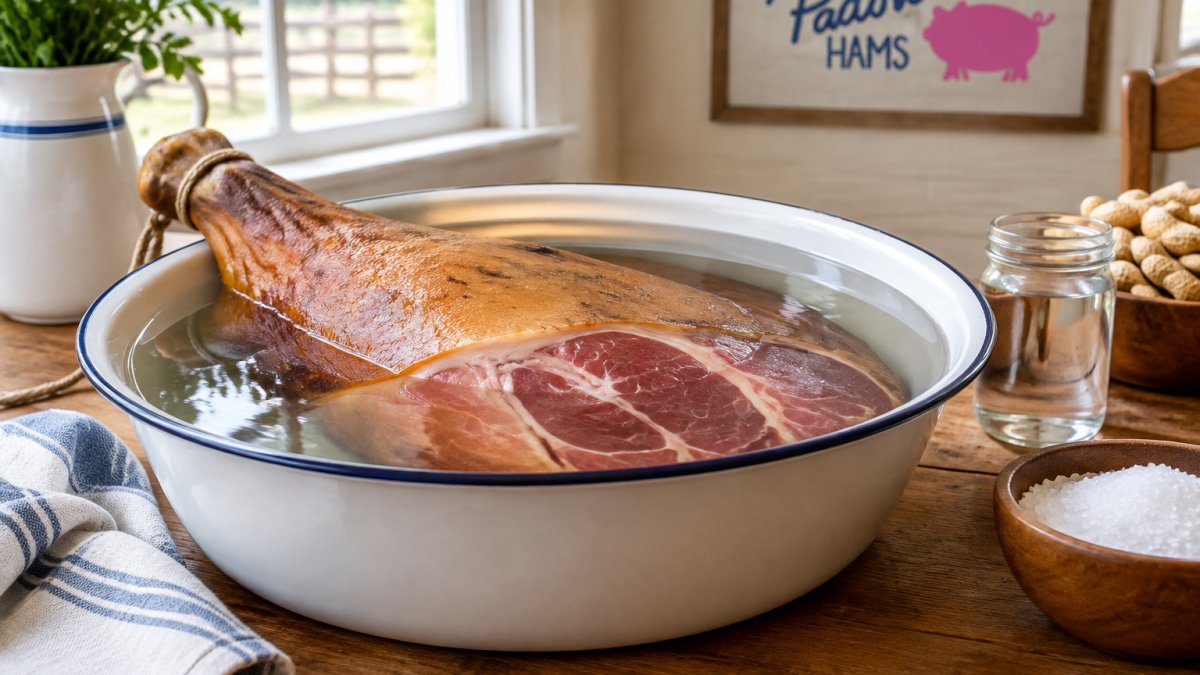
Plain cold water is the traditional choice, and it works. It pulls out excess salt steadily and keeps the flavor of the ham itself front and center.
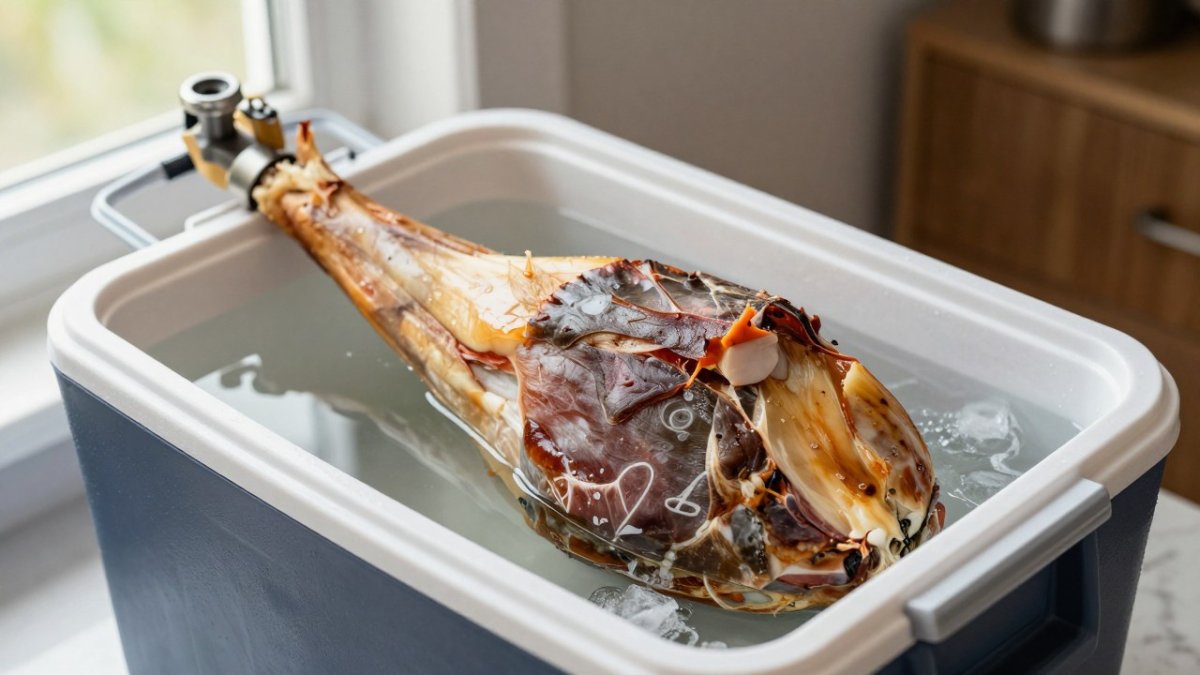
Keep the soak cold to limit bacterial growth. Keep the soak in the refrigerator or in a cooler packed with ice, and keep the water below 40°F the whole time.
Recommended Soaking Times and Water Temperature
Soaking time for a country ham depends on the size of the ham and how salty it is. A whole ham usually needs a longer soak than a few slices. Plan for a full day or more for a whole ham, and check the ham partway through.
Keep the water cold the entire time. Warm water speeds up the salt release but also lets bacteria grow. Cold water is slower, but it is the safer choice.
When to Change the Soaking Water
Change the water every 12 to 24 hours. Fresh water keeps the salt gradient strong, so more salt keeps moving out of the ham. Once the water picks up a lot of salt, it stops pulling as hard.
A common mistake is letting one batch of water sit for too long. If the water looks cloudy or smells off, drain it and start over with fresh cold water right away.
Adding Flavor to the Soak: Apple Juice, Cider Vinegar, and Peach Juice
Plain water is not the only option, but it is the only liquid that does the desalting work on its own. Everything else is an additive, and the useful question is not "which juice tastes best" but "what does this additive do to the salt coming out of the meat." Once you understand that, the ratios and timing stop being guesswork.
What each additive actually does
Salt leaves the ham because the liquid around it is less salty than the meat, so salt moves out through the surface until the two sides balance. Anything you dissolve in the water changes that balance in one of two ways:
- Sugar (apple juice, peach juice, cranberry juice) does not pull salt out. It adds sweetness that masks residual salt on the tongue and gives the surface sugars something to caramelize when the ham hits a hot pan. It also feeds bacteria, which is why a juice soak has to stay colder and get changed more often than a plain water soak.
- Acid (apple cider vinegar, lemon juice) slightly tenderizes the surface and adds tang, but it does not speed up salt removal. Too much acid starts to firm up and "cook" the outer layer of the meat before it ever reaches the skillet, which is why vinegar is a seasoning, not a base.
- Plain water remains the strongest desalting medium per hour. If a ham is very salty, do the desalting in water first and add flavor later, either in a shorter second soak or in the glaze.
Working ratios that hold up
A common pattern among cooks who flavor the soak is to keep the additive at no more than half the total liquid, and often closer to one part additive to three or four parts water:
- Apple juice: mix 1 part juice to 1 part cold water for a mild sweetness, or 1 part juice to 3 parts water if you want the pork to stay the dominant flavor. Straight juice is too sweet and too sugary to sit on a ham for a full day.
- Apple cider vinegar: 1/4 to 1/2 cup per gallon of soaking liquid. That is enough to brighten the surface without firming the meat. Measure it, pouring "a splash" into a cooler is how hams end up tasting like pickles.
- Peach juice: 1 part juice to 2 or 3 parts water. Peach juice is sweeter than apple juice, so it needs more dilution, and it browns faster under a hot broiler.
Timing and layering
Flavored soaks work best as a shorter second stage. Desalt the ham in plain cold water for the bulk of the time, then move it to a flavored soak for the last 8 to 12 hours so the surface picks up the flavor without the sugar sitting on the meat for days.
Watch out: Juice-based soaks spoil faster than plain water, so keep them at 40°F or below the entire time and discard the liquid rather than topping it off. If the liquid looks cloudy, feels slick, or smells sour, the batch is done, start fresh with cold liquid.
What not to add
Skip anything with added salt, broths, bouillon, soy sauce, seasoned marinades, because you are trying to remove salt, not add it. Skip dairy, which will not penetrate the meat and will just spoil.
Each additive changes the soak in a different way, so the table below sums up what each one does and the ratios the article gives for it.
| Additive | Effect on the ham | Suggested ratio |
|---|---|---|
| Apple juice | Mild sweetness, masks residual salt | 1 part juice to 1 part water, or 1 to 3 for a milder taste |
| Apple cider vinegar | Brightens the surface, adds tang | 1/4 to 1/2 cup per gallon |
| Peach juice | Sweeter, browns faster under a broiler | 1 part juice to 2 or 3 parts water |
| Cranberry juice | Most tart, can overwhelm the cure | 1 part juice to 3 parts water |
How Long to Soak Country Ham Slices and Whole Hams
Time-based soaking charts vary wildly from source to source because the right answer depends on the cut, the thickness, and how heavily the ham was cured. Rather than chase a single number, use a starting range and then confirm with your senses. That combination is what most experienced cooks actually rely on.
Starting ranges by cut
These are starting points, not finish lines. Adjust up for a ham that tastes very salty at the first check and down for one that is milder.
- Thin slices (1/4 inch or less): 30 minutes to 2 hours in cold water. Check at 30 minutes by tasting a small piece from the center of a slice.
- Thick slices (1/2 inch to 1 inch): 2 to 6 hours, with one water change at the halfway point.
- Ham steaks and small roasts (2 to 4 pounds): 12 to 24 hours, changing the water once or twice.
Visual and tactile signs the ham is ready
The clock tells you when to check; the ham tells you when to stop. Look for these signs:
- Color: the exterior shifts from a deep, dark mahogany toward a lighter reddish-brown, and the surface looks less dry and leathery.
- Texture: the meat feels slightly softer and more yielding when pressed, and the surface is no longer tacky or stiff.
- Taste: a small piece cut from the outer edge tastes seasoned rather than sharp. This is the most reliable test, salt hits the front of the tongue first, so if the first bite no longer makes you wince, you are close.
Watch out: Do not judge readiness by the color of the water alone. Water turns pinkish-brown from surface pigments long before the interior salt has moved, so a dark soak is not proof the ham is done.
How to rescue a ham that is still too salty
If the ham is still harsh after the planned soak, you have options short of throwing it out:
- Soak longer in fresh cold water. Change the water and give it another 12 hours. Salt keeps leaving as long as the surrounding water stays fresher than the meat.
- Slice before soaking further. Thin slices desalt far faster than a whole ham because more surface area is exposed. If you plan to slice anyway, slice first and soak the slices for another hour or two.
- Simmer instead of soak. Gentle simmering in unsalted water pulls salt out through the same gradient, faster, because heat speeds the movement. Simmer slices for 20 to 30 minutes, then taste.
- Balance at the plate. If the ham is close but still a touch salty, pair it with something sweet or starchy, a biscuit, a sweet glaze, or fruit, rather than soaking it into mush.
Turn and submerge
A whole ham must be fully submerged, and it should be turned over partway through the soak so every surface sees fresh liquid. A ham that floats or sits half out of the water will desalt unevenly, leaving one side noticeably saltier than the other. Weigh it down with a plate if needed, and use a container with enough room that the water can circulate around the meat.
How to Cook Country Ham Slices After Soaking
Once the slices have soaked to your liking, pat them dry. Then cook them in a hot cast-iron skillet over medium heat for a few minutes per side, until the edges brown and the centers are heated through.
For a full walkthrough with cooking times and tips for avoiding the most common mistakes, read our guide: How to Cook Country Ham Slices: Skillet Guide. If you are cooking a whole ham instead, see How To Cook A Country Ham for the complete process.
Planning Your Next Ham Dinner or Corporate Gift Order
A soaked and cooked ham makes a memorable centerpiece for a holiday table or a family dinner. If you are planning a ham dinner and want to skip the soaking altogether, our Padows Country Buffet Ham 661 is ready to serve from our own catalog. We also carry Virginia Peanuts and gift boxes, which make a great pairing for holiday hosts and corporate gifts.
Frequently Asked Questions
What liquid keeps ham moist?
Cold water is the standard soaking liquid for dry-cured country ham because it draws out excess surface salt through osmosis without adding flavor of its own. Keep whatever you use refrigerated below 40°F, since sugary liquids can encourage bacteria if the temperature drifts. Moisture during cooking comes more from covering the ham and cooking it low and slow than from the soaking liquid itself.
How long should I soak ham before cooking?
Soaking time depends on the age and salt level of the ham, and on whether it is a whole ham or slices. Whole aged country hams often need 24 to 48 hours in cold water, with the water changed every 12 to 24 hours. Thin slices need much less time, usually a few minutes to a few hours depending on thickness. Taste a small piece of the ham after soaking to judge whether more time is needed before you cook it.
Can I use apple cider vinegar to soak country ham?
Yes, apple cider vinegar is used in soaking mixtures to cut through heavy salt and add a slight tang. It works best diluted with water or juice, because straight vinegar can overpower the natural pork flavor. Use it in moderation, especially on very old or heavily cured hams. A small amount added to a cold-water soak is a common way to balance a salty ham.
Does soaking country ham make it less salty?
Yes. Soaking draws salt out of the meat through osmosis, which is why it is the main step for reducing saltiness in dry-cured country ham. Regular water changes keep the salt gradient working, so the ham continues to release salt. Taste the ham periodically during soaking and cooking, and stop when it reaches a flavor you enjoy. If the ham still tastes too salty after soaking, a longer soak with fresh water is the usual fix.