 how-to
How to Cook Country Ham Slices: Skillet Guide
Table of Contents
- What You'll Need Before You Cook Country Ham Slices
- Soaking Country Ham Slices to Tame the Salt
- Country Ham Cooking Time: Skillet, Oven, and Broiler
- How to Make Red Eye Gravy from the Pan Drippings
- Common Mistakes That Ruin Country Ham Slices
- Serving Suggestions and What to Do With Leftovers
- No Cast Iron? Equipment Alternatives That Still Work
- Frequently Asked Questions
Last Updated: September 16, 2026
What You'll Need Before You Cook Country Ham Slices
Cooking country ham slices well starts with understanding what you're working with: a salt-cured, aged cut of pork that behaves nothing like a supermarket ham. According to the USDA Food Safety and Inspection Service guide to cured meats, country ham is a dry-cured product that requires different handling than wet-cured or fresh pork. At Padow's Hams Co., we understand that questions about salt and timing are common when preparing country ham.
- A heavy-bottomed skillet, ideally cast iron
- Sharp knife or kitchen shears for trimming
- Cold water and a shallow dish for soaking
- Tongs and a splatter screen
- Black coffee for red eye gravy
- A probe thermometer
Choosing the Right Slice Thickness
Slice thickness decides your cooking method more than any other factor. Thin slices, roughly 3 to 5 millimeters, cook in minutes and crisp at the edges. Thicker slices, closer to 1 centimeter, need lower heat and more patience so the center warms through before the outside toughens.
Soaking Country Ham Slices to Tame the Salt
Soaking country ham slices is the step most recipes rush, and it's the one that decides whether dinner tastes rich or punishingly salty. The process is simple: cover the slices in cold water, refrigerate, and change the water periodically.
Soak Time | Result | Best For |
|---|---|---|
30 minutes | Bold, full salt | Experienced palates |
2-4 hours | Balanced | Most home cooks |
8-12 hours | Mild | Sensitive palates, gravy |
Country Ham Cooking Time: Skillet, Oven, and Broiler
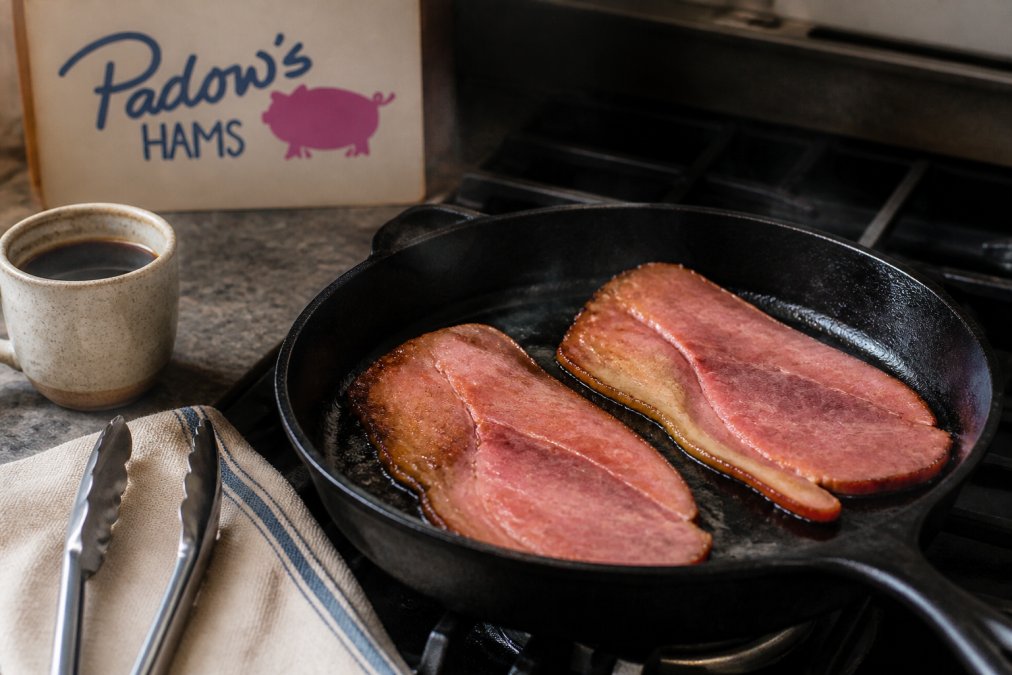
Country ham cooking time runs about 3 to 4 minutes per side in a skillet over medium heat, 12 to 15 minutes in a 350°F oven, or 4 to 6 minutes total under a broiler. The right method depends on thickness and how many slices you're working with.
Skillet Method, Step by Step
The skillet is the classic approach and the one that gives you drippings for gravy.
- Heat your pan over medium heat for 3 to 4 minutes. Add a teaspoon of cooking oil, lard, or bacon grease.
- Lay the slices in the pan without crowding. Leave space between them.
- Cook 3 to 4 minutes per side until the edges brown and the fat cap renders.
- Check the internal temperature. It should reach 145°F.
- Move the slices to a warm plate and deglaze the pan immediately.
Oven and Broiler Method
The oven suits thicker slices and batch cooking. Lay the slices in a single layer on a rack over a sheet pan, add a splash of water or coffee to the pan, and bake at 350°F for 12 to 15 minutes. The rack keeps the meat out of the liquid so the bottom browns.
How to Make Red Eye Gravy from the Pan Drippings
Red eye gravy is nothing more than strong black coffee deglazed in the pan where country ham slices were fried, and it takes about 90 seconds to make. The name comes from the reddish ring the coffee and drippings form in the skillet. Get the ratio right and it is the best two-ingredient sauce in Southern cooking.
The Ratio That Actually Works
A common pattern among experienced cooks is roughly 1/2 cup of coffee for every 2 to 3 slices of ham cooked, adjusted to how much fond is left in the pan. Too little coffee and the gravy turns into a salty paste; too much and you dilute the pork flavor into brown water. If you cooked a large batch, deglaze in stages rather than dumping in a full pot of coffee at once.
Three Ways to Finish It
- Classic: coffee and drippings only. Thin, dark, and bracing. This is the version most old-line Southern cooks make.
- With body: whisk in a teaspoon of flour or a small knob of butter off the heat. The flour thickens; the butter rounds off the bitterness.
- With cream: a splash of heavy cream turns it into a richer pan sauce. Not traditional, but a common modern variation and a good bridge for anyone who finds straight red eye gravy too sharp.
What Separates Good Gravy from a Thin, Bitter Disappointment
- Use coffee you'd actually drink. Weak coffee makes weak gravy, and stale coffee makes bitter gravy.
- Don't let it boil hard. A gentle simmer keeps the flavor clean and prevents the coffee from turning acrid.
- Skip the salt. The drippings carry plenty, especially if you soaked the ham only briefly.
- Deglaze while the pan is still hot. Once the fond cools and sets, it stops dissolving into the coffee.
What to Serve It With
Red eye gravy is traditionally spooned over the ham itself, over grits, or over split buttermilk biscuits. It also works as a dipping sauce for biscuits on the side of a breakfast plate. If you are building a full Southern breakfast, the gravy ties the plate together, ham, eggs, grits, and biscuits all benefit from a spoonful.
Common Mistakes That Ruin Country Ham Slices
Most failures with country ham slices trace back to heat, salt, or timing, and all three are fixable. The troubleshooting list below covers what actually goes wrong in home kitchens.
- Skipping the soak. The ham tastes like a salt lick. Fix: soak 2 to 4 hours next time.
- Heat too high. The outside burns before the inside warms. Fix: medium heat, always.
- Crowding the pan. Slices steam and turn gray. Fix: cook in batches.
- Not drying the slices. No sear, no caramelization. Fix: pat dry with paper towels.
- Overcooking. Cured meat dries out fast. Fix: pull at 145°F and rest.
Serving Suggestions and What to Do With Leftovers
Country ham slices belong on a breakfast plate with eggs, grits, and biscuits, but that's only the beginning. The savory, salty profile pairs well with anything sweet or creamy, which is why it works so well on a charcuterie board next to fruit and soft cheese.
Traditional Southern Pairings
The classic plate is ham, eggs, grits, and a biscuit, with red eye gravy spooned over everything. Beyond that, a few pairings consistently work:
- Grits. Stone-ground or quick, either way the creamy texture balances the salt. A pat of butter and a crack of black pepper is enough.
- Buttermilk biscuits. Split and buttered, or used as the base for a ham biscuit with a drizzle of red eye gravy.
- Fried or scrambled eggs. Runny yolks mix with the ham drippings on the plate.
- Sweet sides. Fig preserves, apple butter, or a slice of cantaloupe cut the salt and fat. This is the same sweet-salty logic behind prosciutto and melon.
- Sharp cheddar and apple. Fold a slice into a sandwich for a lighter meal.
Storing Leftovers
Leftover slices keep in the refrigerator for 3 to 4 days wrapped tightly. The enemy is air, exposed ham dries out and picks up refrigerator odors quickly. Wrap in plastic, then in foil, or vacuum-seal if you have one.
Reheating Without Ruining the Texture
Reheat gently in a covered skillet with a splash of water over low heat. The water creates steam that warms the meat through without drying it out. A microwave works in a pinch on low power, but it tends to toughen the edges. Avoid high heat on reheating, the ham is already cooked, and you are only bringing it back to serving temperature.
Freezing
Freezing works too. Wrap slices individually, then reheat straight from frozen in a low skillet. They won't crisp the same way, but they'll still taste like a proper country breakfast. Frozen slices keep for about 2 to 3 months before quality starts to fade.
No Cast Iron? Equipment Alternatives That Still Work
Cast iron is ideal because it holds heat and gives you a fond worth deglazing, but it isn't the only option. A heavy-bottomed stainless steel skillet performs nearly as well, provided you preheat it properly and use enough fat to prevent sticking.
Frequently Asked Questions
Do you need to soak country ham slices before cooking?
Yes, if you want to control the salt. Country ham slices are salt-cured, so a 30-minute soak in cold water pulls out enough salt to make them pleasant without losing the cured flavor. For very thin slices, 15 to 20 minutes is plenty. Change the water once halfway through for a milder result. Pat the slices completely dry before they hit the pan, or they will steam instead of sear.
How long do you cook country ham slices in a skillet?
For slices about 1/4 inch thick, cook 2 to 3 minutes per side over medium heat. Thicker slices near 1/2 inch need 4 to 5 minutes per side. The ham is fully cooked already, so you are really browning the surface and warming it through. Pull the slices when the edges are browned and the center reads 145°F on an instant-read thermometer. Overcooking turns them leathery fast.
How do you make red eye gravy with country ham?
After frying, pour off most of the fat but leave the browned bits in the pan. Add about 1/2 cup of strong black coffee and a splash of water, then simmer for 1 to 2 minutes while scraping the bottom with a wooden spoon. Taste before adding salt, since the drippings are already salty. Some cooks finish with a small knob of butter for body. Serve it over grits or biscuits.
How do you know when country ham slices are done?
Look for browned edges, a slightly firm center, and an internal temperature of 145°F. The color should shift from deep red to a matte pinkish-brown. If the slice curls and stiffens, it is past done. Country ham is sold fully cured and safe to eat cold, so the goal is texture and warmth, not food safety. When in doubt, pull it early and let it rest a minute.