 ultimate-guide
Buy Authentic Virginia Country Ham: A 2026 Guide
Table of Contents
- What Makes Virginia Country Ham Authentic
- Types of Country Ham: Bone-In, Boneless, and Whole
- How to Cook a Country Ham
- Country Ham Storage Tips
- How to Serve Country Ham
- Why Buy Authentic Virginia Country Ham from Padow's Hams Co.
- Frequently Asked Questions
Last Updated: September 13, 2026
What Makes Virginia Country Ham Authentic
Virginia country ham is a dry-cured, salt-cured pork product aged for months to develop its signature salty, smoky flavor. To buy authentic Virginia country ham, you need to know what separates a genuine, hand-cured ham from a mass-produced imitation.
At Padow's Hams Co., we've watched that distinction blur as retailers slap "country ham" labels on wet-cured pork. The real thing follows a slow process unchanged for generations.
Authenticity comes down to three factors: the cure, the time, and the source. A genuine Virginia country ham is dry-cured with salt and often a brown sugar rub, then slow-aged for weeks or months. No shortcuts, no brine injections.
Traditional Curing and Aging Process
The traditional process starts with a heritage breed hog. The ham is hand-cured with salt, sometimes with brown sugar and spices, then hung to age.
Curing time matters more than most buyers realize. A properly slow-aged ham rests anywhere from a few months to over a year, creating the dense, rich texture and deep salty, smoky flavor that defines country-style ham (pubmed.ncbi.nlm.nih.gov).
The USDA requires commercially sold country hams to meet specific curing and handling standards, which you can review through the USDA food safety and inspection guidance. That oversight is one reason buying from an established producer matters.
How to Verify Authenticity
Verifying authenticity comes down to asking the right questions before you buy. A real country ham producer will state the curing method, aging time, and region of origin without hesitation.
Look for these markers:
- The label says "dry-cured" or "salt-cured," not "brine-cured"
- The producer names a curing time of several months or longer
- The ham has a firm, dense texture and a deep amber to mahogany color
- The producer is transparent about sourcing and aging
If a seller can't answer basic questions about curing time, walk away, the fastest way to avoid paying premium prices for a supermarket ham in disguise.
Types of Country Ham: Bone-In, Boneless, and Whole
Country hams come in three main forms: bone-in, boneless, and whole. Each suits a different host, kitchen, and occasion, so the right choice depends on how you plan to serve it.
Bone-in hams carry the most flavor because the bone and fat keep the meat moist during cooking. They're heavier and take longer to cook, but the payoff is a richer, more traditional result. Boneless hams are easier to slice and ship, popular for gifts and smaller households.
Whole hams are the showpiece option: they feed a crowd and look impressive on a holiday table, which is why they dominate Easter and Christmas menus.
Type | Best For | Cooking Effort | Slicing |
|---|---|---|---|
Bone-in | Maximum flavor, traditional feasts | Higher, longer cook | Moderate |
Boneless | Gifts, small households, easy slicing | Lower | Easy |
Whole | Large gatherings, holiday centerpieces | Highest | Requires a sharp knife |
For corporate gifts sent to many recipients, boneless options travel better and arrive ready to serve. For a family holiday dinner where tradition matters, choose bone-in or whole.
How to Cook a Country Ham
Cooking a country ham is a slow, deliberate process, not a quick reheat. The goal is to draw out excess salt while keeping the meat tender and flavorful.
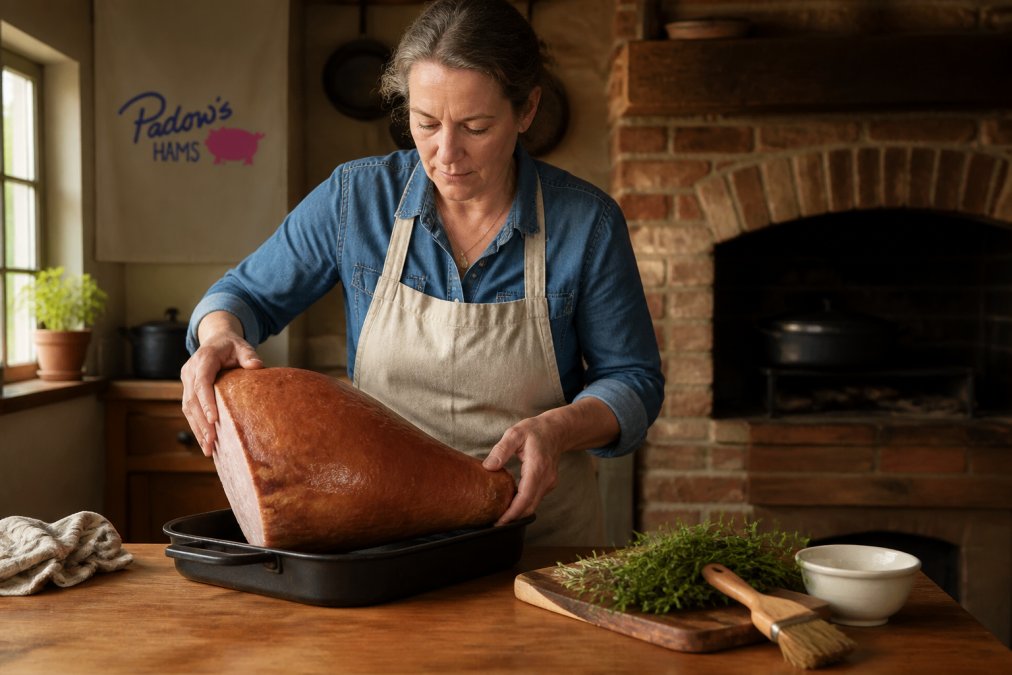
The good news for busy hosts: most of the work is passive. You soak, simmer or bake, and rest. Here's the sequence.
- Scrub the ham under cool water to remove surface mold and excess salt
- Soak the ham in cold water, refrigerated, to pull out salt
- Simmer or bake at a low temperature until the internal temperature is safe
- Glaze near the end of cooking if you want a sweeter finish
- Rest the ham before slicing so the juices settle
A common mistake is skipping the soak. Without it, the finished ham can taste overwhelmingly salty. If you're coming from a wet-cured supermarket ham, expect country ham to be firmer and saltier by design.
Soaking and Preparation Methods
Soaking is the step most first-timers rush, and it decides how the ham tastes. The rule of thumb is roughly 12 to 24 hours in cold water, changing the water several times.
Thinner slices need far less soaking than a whole ham. Pre-sliced country ham usually needs only a few hours.
For food safety during preparation, follow the cold-storage and handling guidance published by the FDA on safe food handling. Keeping the ham refrigerated during soaking prevents bacterial growth while the salt leaches out.
Country Ham Storage Tips
Country ham storage is not one set of rules, it is three, depending on whether the ham is whole and uncured, cut, or cooked. Getting this wrong is the fastest way to ruin an expensive ham, so treat the three states separately.
Whole, Uncooked Hams: The Shelf-Stable Stage
A whole, uncooked, dry-cured country ham is shelf-stable. That is the point of dry curing: salt and moisture loss create an environment where spoilage organisms cannot thrive. Traditional producers hang whole hams in a cool, dry, ventilated space, often a curing barn or basement, for months.
For a home buyer, the practical version looks like this:
- Keep the ham in a cool, dry, dark spot with moving air, a basement corner, a pantry shelf, or a dedicated ham bag or cotton sack
- Target a range that stays cool and stable; large temperature swings are worse than a slightly warm but steady room
- Do not wrap a whole uncured ham in plastic. Plastic traps moisture against the surface and invites mold and off-flavors
- A cotton ham bag or cheesecloth lets the ham breathe while keeping insects and dust off
A white, powdery surface mold on a whole dry-cured ham is normal, part of the aging environment.
Cut Hams: The Clock Starts
Once you cut into a whole ham, the interior is exposed and the shelf-stable advantage disappears:
- Wrap cut surfaces tightly in plastic wrap, then overwrap in foil or a freezer bag to limit oxygen
- Refrigerate cut portions and use them within a reasonable window, plan on a few weeks for a well-wrapped cut ham, less once slices are exposed
- Keep the cut face covered between servings; a ham left open on a counter dries out and picks up refrigerator odors
Sliced and Cooked Ham: Refrigerate and Use Promptly
Pre-sliced country ham and any cooked ham must stay refrigerated. Cooked ham keeps for less time than raw cured ham because cooking changes the moisture and salt balance. Freeze slices you won't use within a few days, country ham freezes well and thaws without much quality loss when wrapped tightly.
Shipping and Transit Storage
How a ham is shipped affects how you store it on arrival. A whole uncured ham shipped in cool weather can go straight to your cool, dry storage spot. A sliced or cooked ham goes into the refrigerator as soon as it arrives. If a ham arrives warm to the touch in summer, refrigerate it immediately and inspect it before serving.
A Quick Spoilage Checklist
- Normal: white surface mold, dry exterior, firm dense texture, deep amber to mahogany color
- Not normal: green or black fuzzy mold, slippery or sticky surface, sour or ammonia-like smell, soft or mushy spots
How to Serve Country Ham
Serving country ham is where tradition and technique meet, and where most buyers get it wrong. The ham is intensely salty and smoky, so thin slices and deliberate pairings matter far more than volume. A thick slab overwhelms the palate; a paper-thin slice lets the cure and aging do the talking.
Slicing Techniques for Whole and Bone-In Hams
Slicing a whole bone-in country ham separates a good experience from a frustrating one, and it's the step most guides skip. Here is the sequence that works.
Set up before you cut. A whole ham is awkward and heavy. Place it on a stable cutting board with the shank end, the narrow end with the bone, pointing toward you. A ham stand or folded towel under the board keeps it from sliding.
Use the right knife. A long, thin, flexible slicing knife (ham knife or carving knife) beats a chef's knife here, length and a narrow blade let you make long, even strokes rather than sawing.
Start on the shank end. It has more bone and less meat, making it the easiest place to learn the angle. Cut thin slices perpendicular to the bone, working toward the center.
Cut against the grain at a slight angle. Country ham is dense and fibrous; cutting straight down compresses the meat, while a slight angle and thin slice give a more tender bite.
Rotate the ham, don't fight it. As you work around the bone, turn the ham so you always cut toward yourself in a controlled stroke. Stop at the aitchbone, the flat, irregular bone near the center, and use a smaller knife to free the meat around it.
For pre-sliced ham, you're done. For a whole ham, slice only what you'll serve and leave the rest intact so it keeps better.
A Real Pairing Guide: Wine, Cheese, and Sides
Country ham's salty, smoky, savory profile is a pairing problem with a clear solution: contrast. You want something sweet, creamy, acidic, or effervescent to cut the salt and reset the palate. Here's how the classics break down.
Wine and beverages
- Sparkling wine or Champagne, the bubbles and acidity scrub the salt off the palate; this is the single most reliable pairing
- Off-dry Riesling, the residual sugar balances the salt without competing with the smoke
- Bourbon or a brown ale, the caramel and vanilla notes echo the cure and the aging
- Strong black coffee or sweet tea, a traditional Southern table pairing that works because bitterness and sweetness both cut salt
Cheese
- Sharp cheddar, the classic; the sharpness stands up to the ham instead of disappearing under it
- Pimento cheese, creamy, tangy, and a staple of the Southern biscuit-and-ham plate
- Aged gouda or gruyère, nutty and firm, a good match for the smoke
- Avoid mild, soft cheeses, brie and fresh mozzarella get buried by country ham's intensity
Sides and condiments
- Buttermilk biscuits with soft butter, the neutral, warm carrier that lets the ham lead
- Fig preserves, honey, or apple butter, sweet counterpoints to the salt
- Fresh melon, apple, or pear slices, juicy and acidic, a summer classic
- Grits, red-eye gravy, or redeye-style pan sauce, the traditional breakfast plate
- Pickled okra, chow-chow, or mustard, acid and crunch to break up the richness
Building a Serving Plate
The rule of thumb: one sweet element, one creamy element, and one acidic element alongside the ham. Thin-sliced country ham, a warm buttered biscuit, a spoon of fig preserves, and a few slices of sharp cheddar covers all three and needs nothing else.
Why Buy Authentic Virginia Country Ham from Padow's Hams Co.
Buying from a producer with real history removes the guesswork. Padow's Hams Co. has been family-owned and operated since 1936.
When you order, you get authentic Virginia country ham made with time-honored methods, not shortcuts. We ship nationwide, so distance from home doesn't mean giving up the flavor you remember. Whether you're hosting a holiday feast or sending a corporate gift, our hams arrive in good condition and impress at the table.
For hosts who don't want to fuss, preparation is straightforward: soak, cook, rest, slice, no special equipment required. For gift buyers, a country ham reads as a thoughtful, premium choice rather than another forgettable food basket.
If you've been comparing options and wondering whether the premium is worth it, the answer is in the process. Slow-aged, hand-cured ham tastes like nothing a mass-produced ham can imitate.
Frequently Asked Questions
What makes a country ham authentic?
Authentic Virginia country ham is dry-cured with salt and often a brown sugar rub, then slow-aged for months. It is hickory-smoked and has a salty, smoky flavor. Look for terms like 'dry-cured,' 'hand-cured,' and 'slow-aged' on the label, and check that the producer follows traditional methods. Padow's Hams Co. has been selling authentic Virginia country hams since 1936.
How do you properly store a dry-cured country ham?
Store a whole dry-cured country ham in a cool, dry place. Once cut, wrap slices tightly in plastic and refrigerate, or freeze for longer. For country ham storage tips, keep it away from moisture and strong odors. If you receive a refrigerated shipping ham, follow the included instructions for best results.
How long should you soak a country ham before cooking?
Soaking time depends on the ham's size and saltiness. Generally, soak a whole country ham for 12 to 24 hours in cold water, changing the water several times. For smaller cuts or slices, 4 to 6 hours may suffice. This reduces saltiness and prepares the ham for cooking. Always follow the specific soaking instructions provided with your ham.
What is the difference between city ham and country ham?
City ham is wet-cured or brined, then often smoked and sold fully cooked, requiring only reheating. Country ham is dry-cured with salt and aged for months, resulting in a firmer texture and saltier, smokier flavor. Country ham typically needs soaking and slow cooking. Both are pork products, but country ham offers a traditional, artisanal experience prized for holiday dinners and special occasions.