 blog
blog
Gourmet Food Gifts for Employees: 2026 Guide
Table of Contents
- Gourmet Food Gifts for Employees: Why They Outperform Generic Corporate Swag
- Corporate Gift Baskets for Employees: What Actually Belongs in One
- How to Choose Corporate Food Gifts Without Guesswork
- Best Practices for Employee Holiday Gifting: Timing, Logistics, and Lead Time
- Seasonal Collections and Customizable Edible Corporate Gifts
- Sustainability and Ethical Sourcing in Corporate Gifting
- Frequently Asked Questions
Last Updated: September 12, 2026
Gourmet Food Gifts for Employees: Why They Outperform Generic Corporate Swag
Gourmet food gifts for employees work because they get consumed, remembered, and talked about, unlike branded mugs that end up in a drawer. This guide from Padow's Hams Co. covers how to choose, budget, and ship them without guesswork.
The average desk drawer holds three unused logo pens and a stress ball nobody asked for. A cured ham, a box of artisan treats, or a curated hamper disappears in a week, and people actually mention it in the break room.
At Padow's Hams Co., we have shipped handcrafted Virginia country hams and Southern specialties nationwide since 1936 (virginia.gov). Edible gifts often outperform logo merchandise on measures like recipient satisfaction and client retention.
Below, we break down what belongs in a corporate gift basket for employees, how to filter for dietary restrictions, and how to plan lead times so nothing arrives late.
Corporate Gift Baskets for Employees: What Actually Belongs in One
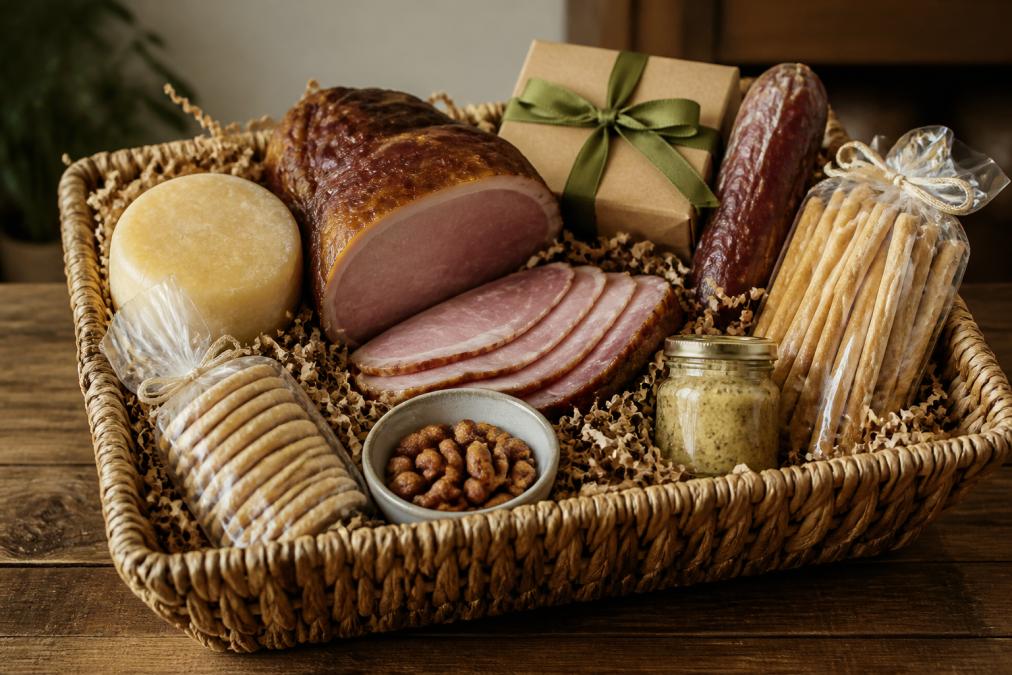
A strong corporate gift basket for employees pairs one anchor item with three to five supporting items. The anchor is the memorable centerpiece, usually a cured meat, a premium cheese, or a chocolate tower. The supporting cast adds variety without crowding it.
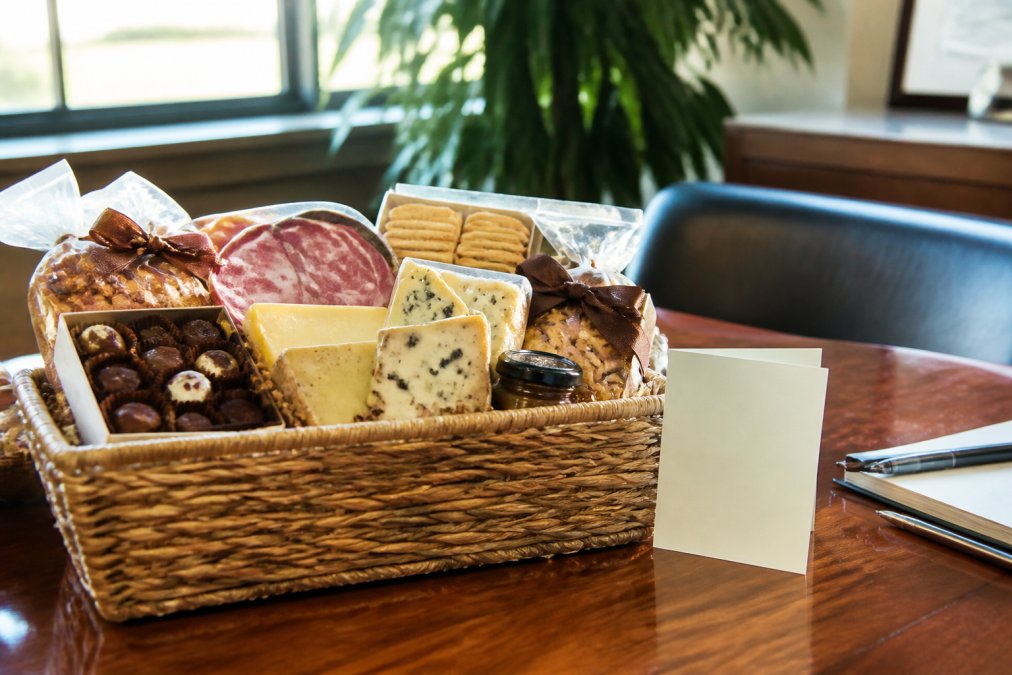
What most guides miss is that balance matters more than volume. A basket stuffed with twelve snack bags reads as filler. A basket with one excellent anchor, a savory snack, a sweet item, and a personalized note reads as intentional.
A reliable structure looks like this:
- One anchor: country ham, smoked sausage, or a gourmet cheese selection
- One savory snack: crackers, seasoned nuts, or cured olives
- One sweet item: chocolates, preserves, or shortbread
- One texture contrast: something crunchy or crisp to balance the soft items
- A personalized note: the single cheapest upgrade with the highest impact
Savory vs. Sweet: Matching the Basket to the Recipient
Savory selections suit recipients who cook, entertain, or prefer wine pairings. Sweet selections suit offices with shared kitchens and mixed preferences. When in doubt, a savory anchor with one sweet accent covers more ground than an all-chocolate tower.
Dietary Restriction Filtering: Making Sure Everyone Gets Something
Dietary restriction filtering means checking every recipient list against common restrictions before ordering, not after. Pork, nuts, dairy, gluten, and alcohol are the five categories that cause the most problems in bulk corporate gifting (the FDA).
How to Choose Corporate Food Gifts Without Guesswork
Choosing corporate food gifts comes down to three variables: recipient count, budget per person, and delivery window. Lock those three first, and the product decision becomes straightforward.
Most guides stop there. The harder problem, the one HR managers actually lose sleep over, is scaling a gourmet feel across a team of 50, 200, or 500 people without the per-head cost collapsing into dollar-store territory. That is a math problem before it is a product problem.
The Per-Head Budget Math for Large Teams
Start with a realistic per-head range and work backward into the product. A common pattern among corporate buyers is to tier the budget by recipient relationship:
- $25-$40 per head: a single anchor item plus a printed note card. Works well for broad employee distribution lists.
- $50-$75 per head: a small curated box with one anchor, one savory, and one sweet item. Typical for direct reports and cross-functional partners.
- $100+ per head: a full basket or hamper with branded packaging. Usually reserved for executives, long-tenured employees, or key clients.
At 50 employees, a $30 per-head budget is $1,500 before shipping. At 200 employees, the same budget is $6,000. Shipping is the variable most buyers underestimate: multi-address fulfillment on perishable or temperature-sensitive items can add a meaningful per-unit cost, and that cost scales linearly with headcount. Confirm shipping quotes at your actual recipient count before you commit to a per-head number.
How to Keep the Gourmet Feel at Scale
Budget-friendly bulk gifting works when you shrink the basket, not the quality. A single excellent anchor item with a personalized note lands better than a large basket of mediocre filler.
Three mechanisms preserve the premium feel even at high volume:
- Anchor concentration. Spend 60-70% of the per-head budget on one memorable item, a cured ham, a smoked sausage, a small-batch preserve, and let the supporting items be simple.
- Personalization at the note, not the product. A handwritten or printed note with the recipient's name costs almost nothing per unit and is the single highest-leverage upgrade in the entire order.
- Uniform packaging, varied contents. Identical boxes with different anchor items inside let you negotiate a single packaging run while still giving recipients something that feels chosen for them.
Most buyers assume volume signals generosity. Recipients read it the opposite way: one item done well signals that you thought about them, while a crowded box signals that you bought in bulk and moved on.
When Bulk Ordering Beats Individual Orders
Bulk ordering for corporate events unlocks two things individual orders cannot: negotiated per-unit pricing and consolidated shipping to a single address. If your recipients are all in one office, ship the entire order to that office and distribute internally, this is almost always cheaper and faster than 200 individual shipments.
If recipients are distributed, ask your vendor whether they offer multi-address fulfillment as a single order with a single invoice. Many gourmet food vendors do, and it eliminates the administrative nightmare of tracking 200 separate order confirmations.
| Step | Action | Time Needed |
|---|---|---|
| 1 | Confirm recipient count and addresses | 1-2 days |
| 2 | Set budget per recipient and tier by relationship | Same day |
| 3 | Survey dietary restrictions | 3-5 days |
| 4 | Request bulk pricing and shipping quotes at final headcount | 2-3 days |
| 5 | Order one test unit | 1 week |
| 6 | Place bulk order with lead time buffer | 2-3 weeks before delivery |
Best Practices for Employee Holiday Gifting: Timing, Logistics, and Lead Time
Best practices for employee holiday gifting start with a calendar, not a catalog. Holiday gifting volume peaks in November and December, and perishable goods need tighter coordination than shelf-stable items. The single most common failure mode is not choosing the wrong gift, it is choosing the right gift too late to arrive on time.
A Working Gifting Calendar
Work backward from your target delivery date. The timeline below reflects the lead times most gourmet food vendors need during peak season, when production and carrier capacity tighten.
| Weeks Before Delivery | Action |
|---|---|
| 10-12 weeks | Finalize recipient list, budget tiers, and dietary restrictions |
| 8-10 weeks | Request vendor quotes, sample units, and bulk pricing |
| 6-8 weeks | Place the order; confirm shipping method and delivery window |
| 4-6 weeks | Confirm addresses; send the final headcount to the vendor |
| 3-4 weeks | Vendor ships; track multi-address orders weekly |
| 1-2 weeks | Buffer window for weather delays and re-ships |
If your target delivery date is the week before a major holiday, add two weeks to every row above. Carrier networks hit capacity limits in mid-December, and a one-day weather event in a hub city can cascade into multi-day delays across the country.
Nationwide Shipping and Perishable Goods: What to Expect
Nationwide shipping handles shelf-stable items like cured hams and preserves far more predictably than perishable goods. Cured and smoked products travel well; fresh items need expedited shipping and tighter delivery windows.
Three logistics rules that prevent most holiday failures:
- Match the shipping method to the product. Shelf-stable items can ship ground. Temperature-sensitive items need expedited service and, in warm months, cold packs or insulated liners.
- Stagger shipments by region. If you are sending to multiple offices, stagger shipments by region rather than sending everything on one date. It reduces the chance that a single weather delay disrupts every delivery.
- Ship to a staffed address. A gift that arrives at an empty office on a Friday sits in a mailroom until Monday. Confirm someone will be there to receive it, especially for perishable items.
What to Do When Something Goes Wrong
Even with a calendar, some orders will miss. Build a small contingency into the budget, a common pattern is to reserve 3-5% of the total order value for re-ships and replacements. Keep a short list of shelf-stable backup gifts you can ship overnight if a perishable order is delayed past its window. A preserved-food gift that arrives a day late is a minor inconvenience; a fresh item that arrives spoiled is a complaint.
Finally, document what you ordered, for whom, and when it shipped. The following year, that record is the fastest possible starting point for the next cycle, and it prevents the awkward situation of sending the same gift to the same recipient two years running.
Seasonal Collections and Customizable Edible Corporate Gifts
Seasonal collections give corporate gifting a natural rhythm: spring hampers, summer picnic sets, fall harvest boxes, and winter holiday selections. Customizable edible corporate gifts add corporate branding through packaging, ribbon, or a printed note card without touching the food itself.
Branding the packaging rather than the product keeps the gift feeling personal. A logo on a ribbon reads as thoughtful; a logo stamped on the food reads as promotional.
Sustainability and Ethical Sourcing in Corporate Gifting
Sustainability and ethical sourcing matter more to recipients each year, and food gifts have a structural advantage: they produce no plastic trinkets destined for a landfill. Look for recyclable packaging, minimal single-use plastic, and producers who can speak to how their ingredients are sourced.
Small producers with traceable supply chains usually cost more per unit, and that premium is the point. A gift that carries a real story about where it came from is harder to forget than a generic assortment.
Frequently Asked Questions
What are some luxurious gourmet food gifts I can give my employees?
Consider artisan-cured meats, aged cheeses, small-batch chocolates, infused olive oils, or curated hampers with shelf-stable gourmet items. Virginia country ham is a standout option because it carries regional heritage and arrives ready to serve. Pair it with a personalized note and branded packaging to elevate the presentation. The key is choosing items that feel indulgent but are easy for the recipient to enjoy without extensive preparation.
How do you choose professional food gifts for a diverse team?
Start by surveying dietary restrictions and preferences across your team. Look for vendors that offer customizable packaging and the ability to filter for gluten-free, nut-free, or vegetarian options. Avoid perishable goods with short shelf lives unless you can coordinate delivery timing. Shelf-stable items like cured meats, crackers, and chocolates travel well and accommodate more diets. When in doubt, offer a choice between two curated options.
What gifts do employees value most from corporate food gifting?
Employees tend to value gifts that feel personal and high-quality over generic branded merchandise. Gourmet food gifts work well because they are shareable, consumable, and don't clutter a desk. Employees often prefer receiving food or experience-based gifts over branded swag. The presentation matters too: a handwritten note and attractive packaging increase perceived thoughtfulness significantly.
How far in advance should I order gourmet food gifts for employees?
For holiday gifting, place orders at least three to four weeks before you need delivery. Bulk orders of perishable goods like cured meats or artisanal cheeses require coordination with the vendor to ensure freshness and timely arrival. If you're shipping to multiple addresses nationwide, add an extra week for logistics. Confirm lead times with your vendor early, especially during November and December when demand peaks.
Corporate gifting gets complicated fast once you add dietary restrictions, shipping windows, and dozens of recipients to the same order. Padow's Hams Co. has handled that complexity since 1936, with handcrafted Virginia country hams, traditional curing methods, and nationwide shipping that keeps quality intact from our smokehouse to your recipients' doors. Get started with Padow's Hams Co. and give your team a gift they will actually remember.